
pickomino
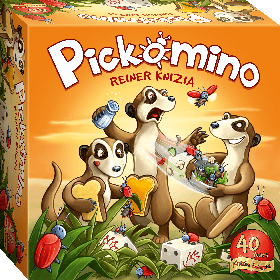 The meerkats have discovered a new delicacy: red fire beetles who love being admired and gently nibbled for their spicy glow. When the sun goes down and the beetles begin to shine, the meerkats gather along the beetle trail to collect the most sparkling beetles.
In this fast-paced, push-your-luck dice game, you roll, risk, and re-roll the dice to attract the happiest fire beetles to your side — or even charm a beetle swarm away from another player!
The meerkats have discovered a new delicacy: red fire beetles who love being admired and gently nibbled for their spicy glow. When the sun goes down and the beetles begin to shine, the meerkats gather along the beetle trail to collect the most sparkling beetles.
In this fast-paced, push-your-luck dice game, you roll, risk, and re-roll the dice to attract the happiest fire beetles to your side — or even charm a beetle swarm away from another player!
Niver a c'hoarierien: 2 - 7
Padelezh ar bartienn: 16 mn
Kemplezhded : 1 / 5
C'hoari da pickomino pe da 1414 c'hoari all enlinenn.
Pellgargañ ret ebet - c'hoariit war-eeun adalek ho merdeer.
Gant ho mignoned ha miliadoù c'hoarierien/ezed en hollved.
Evit netra.


C'hoari da pickomino pe da 1414 c'hoari all enlinenn.
Pellgargañ ret ebet - c'hoariit war-eeun adalek ho merdeer.
Gant ho mignoned ha miliadoù c'hoarierien/ezed en hollved.
Evit netra.
Diverradenn ar reolennoù
Pickomino
Introduction
Pickomino is a dice drafting and tile collecting game with "push your luck" elements.
The BGA game is based on the 40th anniversary edition, in which players are meerkats competing to gather tasty bugs.
Objective
The goal of the game is to gather more bugs than your opponents. You do this by using a combination of dice rolls to either win tiles from the playing area or steal tiles from other players.
Game Play
1. Roll the dice. Choose one die face. All the dice matching that die face are moved and put into the "collection line" below the game board.
- For example, if you rolled some 3s, you could choose them and they would all be added to the collection line.
2. Once you've added dice to the collection line, you can choose to re-roll the remaining dice. However, you cannot choose any dice fave/value that is already in the collection line.
- For example, you might roll a 5 and decide to add it to the collection line. If you choose to re-roll the remaining dice and get additional 5s, you will not be allowed to choose them.
3. Your score so far is shown on the right hand side of the collection line. This is calculated as a total of all the dice pips, plus 5 points for each "paw print" die face.
4. To win a tile, you must have at least 1 paw print in your line by the end of the turn.
5. Continue re-rolling dice until either:
- - You are happy with your current score, or
- - There are no more dice to roll, or
- - You can't add any more dice to your line, in which case you BUST
You can now do the end of turn actions.
End of Turn Actions
If you have busted, not scored enough to collect a tile, or you do not have a paw print, you will not be able to collect a tile. In this case, you lose the top-most tile from your hand, which is returned to the centre, and the highest-value tile in the middle is flipped face-down, removing it from play. (If you don't have any tiles, there is no penalty and no tile is flipped.)
If you have a paw print in your line, you may now choose a tile from those available:
- - If a tile (whether in the centre or on the top of another player's stack) exactly matches the sum of your dice in the collection line you must take it.
- - Otherwise, you may take any tile that is worth less than your score from the playing area.
Your new tile is placed on top of any existing tiles you have already collected. This protects the existing tiles, as your opponents can only steal the top-most tile.
Play now passes clockwise to the next player.
End of Game
The game ends when there are no more tiles available in the centre.
Final scores are calculated by the number of bugs shown on each tile (not the tile value). The player with the most bugs is the winner.
If there is a tie, the player with the highest numbered tile in their possession is the winner.
Hints
- - Remember that you need to add at least one paw print to your dice collection line, on each turn.
- - To get higher value tiles, you could hold out for more than one paw print to boost your score, but you run the risk of getting none.
- - Lower value tiles are easier to obtain, but are also easier for opponents to steal.
- - Remember that the final score is based on the number of bugs on the tile, not the value of the tiles.